
‘Act Now’, Says World Bank As Flood Displaces 404 Million Students From School Globally
The World Bank has called on governments of countries affected by severe flooding, to take immediate steps to forestall future occurrences as no fewer than 404 million students globally have been unable to access their schools due to climate-related issues, including floods between January 2022 and June 2024.
A report by the World Bank titled “Choosing Our Future: Education for Climate Action,” connected the huge statistics to at least 81 countries, including Nigeria temporarily shutting down schools due to floods, storms, and heatwaves.
According to the World Bank, climate change, including floods, is causing significant school closures, adding that the disruptions remained largely invisible because relevant authorities are not tracking them.
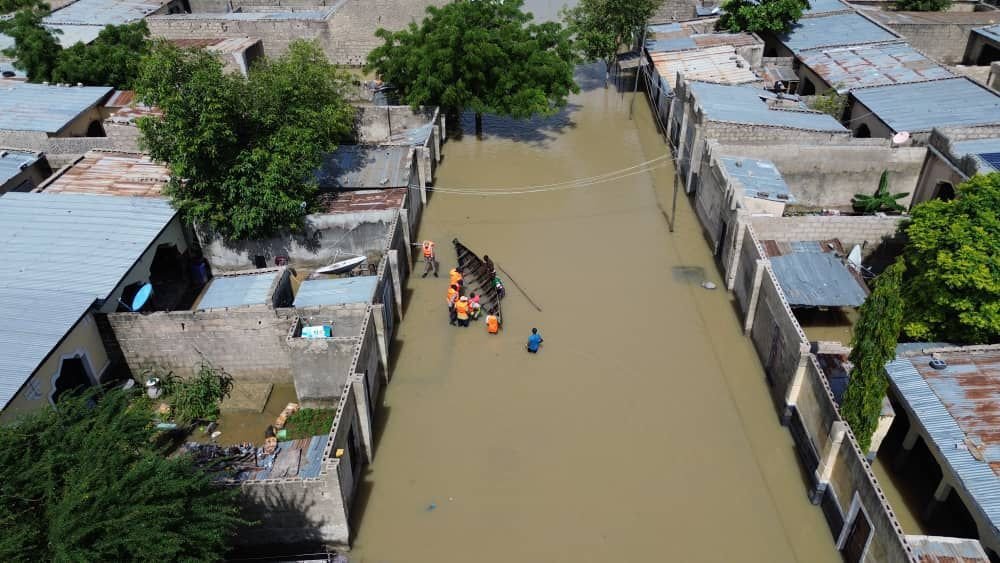
The report comes as Nigeria currently battles high-levelled flooding due to incessant rainfalls which had sacked residents from their homes and communities, with the latest and most touching reports coming from Maiduguri, the capital of Borno State. The overflow of the Alau Dam caused the Maiduguri flooding, and displaced nearly two million people in Maiduguri and surrounding areas.
The report stated, “Education can propel climate action but at the same time, climate change is impeding education.
“Climate change is increasing the frequency and intensity of extreme weather events such as cyclones, floods, droughts, heatwaves, and wildfires, as well as the probability of co-occurring events. These extreme weather events are increasingly disrupting schooling and precipitating learning losses and dropouts.
“Climate change is causing massive school closures. These disruptions remain invisible because they are not being tracked. There is no official data on the frequency and severity of school closures due to extreme climate events. Consequently, this crisis is going largely unnoticed.
“Novel analysis for this report shows that over the past 20 years, schools were closed in at least 75 per cent of the climate-related extreme weather events impacting five million people or more.
“Most worryingly, the frequency and severity of school closures continue to grow due to climate change.
“Between January 2022 and June 2024, an estimated 404 million students faced school closures due to extreme weather events.
“This was the result of at least 81 countries shutting down schools temporarily due to floods, storms, and heatwaves.”
The report also mentioned that for less than $20 per student, schools can adapt and minimise learning losses.
“Climate-related school closures mean students are losing days of learning. Even when schools are open, students are losing learning due to rising temperatures.

“Governments can take steps to harness education and learning for climate action by, for example, improving foundational and STEM skills, mainstreaming climate education, and building teacher capacity. Governments can also prioritize green skills and innovation in tertiary education to help accelerate the shift to more sustainable practices.
“Despite their prevalence, climate-related school closures remain invisible because no one is tracking them.
“Education systems can empower, equip, and skill young people for climate mitigation and adaptation. At the same time, climate change-induced heat and extreme weather events are significantly disrupting learning, with low-income countries being disproportionately affected. Governments must act now to adapt education systems for climate change.
“Education is a key asset for climate action. Education reshapes behaviours, develops skills, and spurs innovation—everything needed to combat the greatest crisis facing humanity.
“Better educated people are more resilient and adaptable, better equipped to create and work in green jobs, and critical to driving solutions.
“Yet, education is massively overlooked in the climate agenda. Almost no climate finance goes to education. Channelling more climate funding to education could significantly boost climate change mitigation and adaptation.
“At the same time, climate change is a huge threat to education. Millions of young people face lost days of learning because of climate-related events. In low-income countries, the situation is worse. Unless made up, this lost learning will negatively impact future earnings and productivity. It will also lead to greater inequality both within and across countries.
“The economic losses and human cost of climate change are enormous. Despite this, climate action remains slow due to information gaps, skills gaps, and knowledge gaps. Education is the key to addressing these gaps and driving climate action around the world. Indeed, education is the greatest predictor of climate-friendly behaviour. Better educated people are more resilient and critical to spurring innovation and climate solutions,” the report said.