
ECOWAS leaders to visit Mali, asks military junta to reinstate Keita’s government
Leaders of Economic Community of West African States, ECOWAS, have resolved to visit Bamako, Mali following the sack of President Ibrahim Boubacar Keita’s government.
They also demanded that the military junta that seized President Keita and sacked his government reinstate him without further delay.
These were some of the resolutions of ECOWAS leaders after an emergency summit called to review the situation in Mali on Thursday. They also announced plans to visit Bamako, the Malian capital, amid growing concerns about regional stability.
Keita was forced to resign in the early hours of Wednesday by soldiers who toppled his government on Tuesday.
Other resolutions taken at the extra-ordinary session are:
- Firmness on the restoration of constitutional order;
- Release of those arrested;
- Stoppage of economic relations with Mali, with exceptions granted to staple foods, fuel and medication, for the sake of the people.
They also called for continued engagement with all parties to the crisis, and mandated former President Goodluck Jonathan, the Special Envoy on the crisis, and ECOWAS Commission President Jean-Claude Kassi Brou, to convey the decisions of the West African leaders to the parties.
The 15-nation bloc convened the virtual Extra-ordinary Session on the socio-political situation in Mali after it suspended it, shut off borders and halted financial flows in response to the overthrow of Keita.
President Muhmmadu Buhari advocated stiffer sanctions on the military regime to force a speedy return to democratic rule.
He lamented that the situation in Mali is a setback for regional diplomacy, which, according to him, poses a threat to the peace and security of the West African region.
The Nigerian President, who condemned the Malian military for breaching the very letter and spirit of the ECOWAS protocol on good governance and democracy, urged leaders of the region to ensure that the breach of protocol in Mali does not survive.
He called for the unconditional release of the ousted President, his Prime Minister and other government functionaries held with him.
Buhari hailed the African Union, AU, the United Nations, UN, and other international bodies for condemning the military coup and urged them to work with ECOWAS to restore peace and order in the country by insisting on the supremacy of constitutional provisions.
The President said: “The action of the military runs counter to the letter and spirit of ECOWAS Protocol on good governance and democracy in which unconstitutional change of governments is prohibited.
“The Authority of ECOWAS Heads of State and Government should not allow this dastardly act to stand. Nigeria stands by the provisions of the Protocol on Good Governance and Democracy.
“Mali has been in political turmoil since the results of the parliamentary elections were announced in March. ECOWAS interventions, through series of efforts by ministers, the special envoy and chief mediator and a group of heads of states of our organisation as well as an Extraordinary Summit did not yield positive results. Today, Mali has not only descended into political chaos, but also socio-economic and security disaster with potentially tragic consequences to Mali and the entire region.
“I am pleased that ECOWAS, EU, UN and France issued strongly-worded statements against the action of the Malian military. The events in Mali are great setbacks for regional diplomacy which have grave consequences for the peace and security of West Africa. I am pleased, therefore, that this extra-ordinary summit, holding to discuss pathways to the debacle we face today in Mali, is most timely and appropriate.
“The closure of borders already called for by ECOWAS should be our first line of action. We need to isolate a series of sanction regimes that can create and sustain sufficient pressures on the military to force a return to constitutional governance.
“The critical issues for resolution in the Malian crisis had been aptly captured as the four-point pathways to peace. Within that context, and if all parties to the crisis were to abide by those recommendations, the developments now on the ground would have been avoided.”
He added: “The action of the military in Mali has regrettably hoisted on us as a sub-region, the need to decide the options that will be consistent with the provisions of the Protocol on Good Governance and Democracy, which ECOWAS, AU and the UN subscribe to. In this context, therefore, Nigeria believes that President Keita and other detainees should be released unconditionally and with immediate effect.
“Furthermore, we strongly support the efforts of our Chairman, President Mahamadou Issoufou, for wider, regional and continental consultations with ECOWAS, AU and UN in adopting strong measures to promoting early restoration of constitutional order, peace and stability in Mali.
“Military involvement in governance, in whatever guise, is an aberration that has no place in managing the business of government that suspends the Constitution and with it, democratic institutions. It is time for the unconstitutional “authority” in Mali to act responsibly and do the needful by heeding to the above recommendations.”

The UN expert on human rights in Mali on Thursday condemned the arrest and detention of Keita in the military coup and called on the coup leaders to release him and members of his government and to protect their physical integrity as well as members of their families.
The United Kingdom (UK) on Thursday called for all parties in the crisis to engage in constructive talks aimed at easing tensions and re-establishing a civilian government in the West African nation, following a military coup.
“I call on all parties to maintain calm, ensure full respect for human rights, and engage in constructive dialogue to ease tensions. All those detained during these tumultuous events must be released immediately”, UK’s Minister for Africa, James Duddridge, said in a statement.
The military operation by the French forces will continue in Mali, Minister for the Armed Forces Florence Parly said yesterday.
“The Barkhane Operation, asked for by the Mali population and authorized by the UN Security Council, continues,” Parly said on twitter.
About 5,000 French troops initiated the Barkhane Operation in 2014 in Sahel to help G5 Sahel countries – Burkina Faso, Chad, Mali, Mauritania and Niger – maintain control of their territory while also preventing the region from becoming a safe haven for Islamist groups.
Mali is already in the grip of a jihadist insurgency and civil unrest.
Within Mali, the M5-RFP coalition of opposition groups said it was working with the mutineers. It labelled ECOWAS’s initial response to the coup as an over-reaction stemming from some regional leaders’ fears that it could set off unrest in their countries.
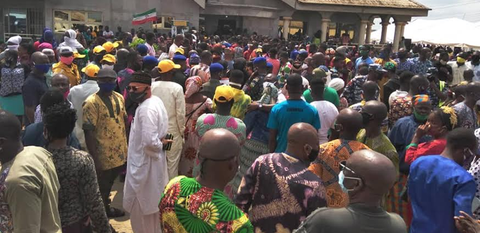
Bamako was calm for the second straight day yesterday, as people appeared to heed earlier calls from junta spokesman Colonel Ismael Wague to return to work and go about their daily lives.
Some Malians also on Thursday welcomed the recent military coup and hoped that the power will finally be handed down to a civilian government, a member of workers’ trade union, Diawara Zainab Sidibe, told Sputnik.
“The hardest times are yet to come … For us, this is a start, a good start, and we welcome it. We hope that the military is telling the truth and will comply with its obligation to transfer power to civilians,” Sidibe said.
An activist of the opposition June 5 Movement, Imam Oumarou Diarra, believes that the Economic Community of West African States’ sanctions will not have a significant impact on the country.
Businessman Kiniko Albert, however, condemned the military coup.