
Terrorism: FG Disagrees As Nnamdi Kanu’s Lawyer Says Threats Mere Boast
Justice James Omotosho of the Federal High Court, Abuja, has been urged to order the leader of the proscribed Indigenous People of Biafra (IPOB), Nnamdi Kanu, to enter a defence in the alleged terrorism charge brought against him by the Federal Government.
The Counsel for the Prosecution, Adegboyega Awomolo (SAN), who made this request during Friday’s proceedings, urged the court to reject the no-case submission made by the defence.
He prayed the court to instead order him to explain why he engaged in alleged terrorist activities that promoted violence and destruction, including the alleged killing of not less than 170 security officials.
While adopting the prosecution’s address in opposition to the no-case submission made by Kanu, Awomolo said the prosecution has supplied sufficient evidence in proof of all elements of the offences charged to warrant the court to call on the defendant to enter a defence.
He noted the prosecution called five witnesses and tendered many exhibits, including video and audio video, adding that as against the claim by defence lawyer, Kanu Agabi (SAN), the reply address of the prosecution addressed all issues raised, to the effect that the no case submission is of no moment.
Awomolo, who prayed the court to dismiss the no-case submission, argued that all the court was required to do at this stage of the case was to take a panoramic view of the evidence led so far and determine whether or not a prima facie case has been made out against the defendant to warrant his being called to enter a defence.
He noted that the defence, in its no-case submission, attacked the credibility of the witnesses, the record and evidence led so far, which is not what is required at this stage.

‘Kanu Aimed To Create Biafra State’
Pointing out why the court should reject the no-case submission, Awomolo noted that in both the video and audio evidence tendered by the prosecution, Kanu admitted being the leader of IPOB, which he knew was a proscribed group.
He added that Kanu also, in some other videos, admitted making broadcasts in which he allegedly called for violence and destruction.
Reading a portion of the defendant’s address in support of his no-case submission, Awomolo faulted Kanu’s lawyer’s argument that his several broadcasts amounted to a clear case of boasting that did not require criminal prosecution.
Awomolo argued that the law prohibits statements that have the possibility of causing fear in the minds of the people.
He said, “Why will somebody say a terrorist, who boasted that security men and other people should be killed, should be allowed to go free?”

Awomolo argued that the defendant aimed to create the separate state of Biafra, and in the process, not less than 170 security men were killed because of his boasting.
“Why was he boasting? Boasting is not the answer. If the defendant believes that he was merely joking and was a content creator, he should be made to answer why he was boasting and creating fear in the minds of the people.

Awomolo added that “when a person is boasting and threatening death and violence, that cannot be said to be mere boasting”.
He urged the court to call on the defendant to come and explain what his boasting was about.
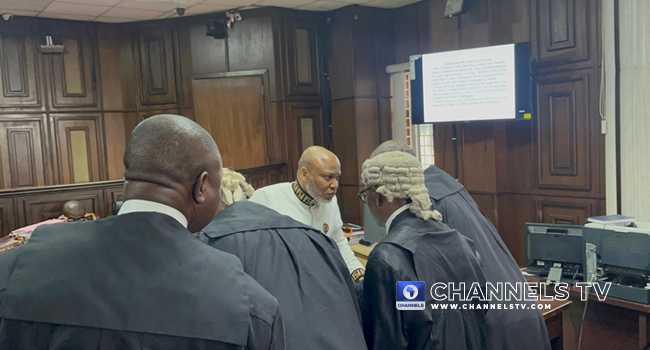
Awomolo faulted the claim by Agabi that the defendant has been in solitary confinement for 10 years now.
The prosecuting lawyer noted that Kanu, who was first arrested in 2015, was granted bail in 2017, which he enjoyed until June 2021, when it was revoked because he jumped bail.
Awomolo said the current detention of the defendant was upon an order of the court, which found that he jumped the earlier bail granted to him.
He also accused the defence legal team of being behind the delays experienced in the case before now.
“Their claim that this case has lasted for 10 years is not true. They are the cause of the delay,” he said.
On Kanu’s argument that IPOB was not lawfully proscribed, Awomolo contended that since the issue was currently before the Supreme Court, it would be inappropriate for the trial court to pronounce on whether or not the proscription was properly done.