

Charles III Crowned King At First UK Coronation In 70 Years
Charles III was crowned monarch of the United Kingdom and 14 Commonwealth realms on Saturday at Britain’s first coronation for 70 years, during a ceremony steeped in a millennium of ritual and spectacle.
After a lifetime as heir to his late mother Queen Elizabeth II, Charles, 74, became the oldest sovereign yet to be crowned at London’s Westminster Abbey.
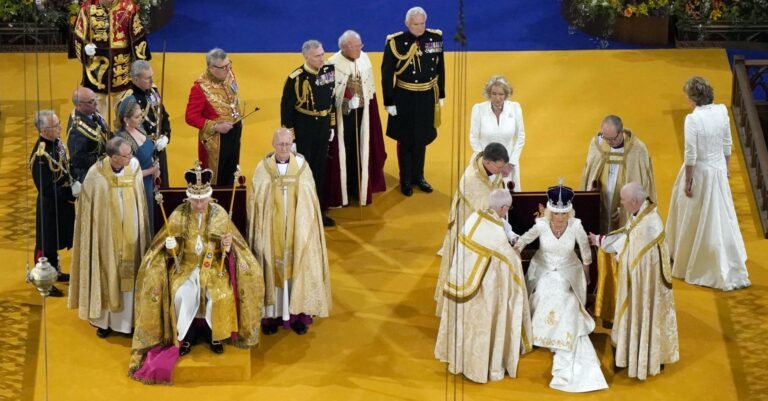
At 12:02 pm (1102 GMT), Archbishop of Canterbury Justin Welby placed the solid-gold St Edward’s Crown on Charles’s head as a sacred and ancient symbol of the monarch’s authority.
Welby also crowned Charles’s wife, Queen Camilla, 75.
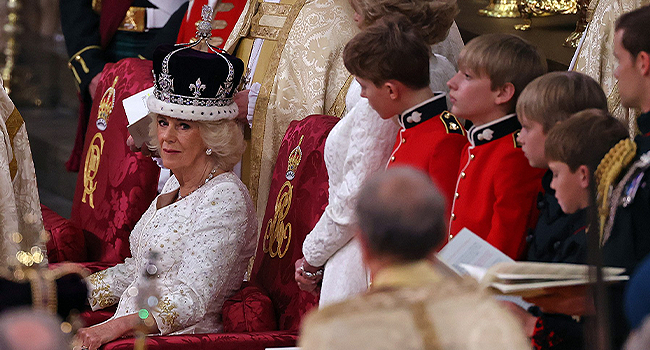
Cries of “God Save the King” rang out from the 2,300-member congregation, which included foreign royalty and political leaders.
US President Joe Biden, represented at the abbey by First Lady Jill Biden, tweeted his congratulations and paid tribute to the “enduring friendship” between the United States and Britain.
Trumpet fanfares sounded along with gun salutes across Britain and beyond.
Returning to Buckingham Palace in the day’s second horse-drawn parade, the royal family appeared on the balcony to applause and more chants of approbation from tens of thousands of well-wishers braving a spring downpour.
Some had camped out for days. A ceremonial fly-past was scaled down due to the weather.
Not everyone joined in the celebration, however.
Shortly before the coronation, London police arrested dozens of protesters using new powers rushed onto the statute book to crack down on direct action groups.
The anti-monarchy movement Republic — which wants an elected head of state — said six of its organisers were detained, while climate activists Just Stop Oil said 19 of its number were held.
Nevertheless, dozens of Republic activists held aloft banners on the route of the procession route, declaring: “Not My King.”
Human Rights Watch, Amnesty International and other campaign groups condemned the arrests. “This is something you would expect to see in Moscow, not London,” HRW said.

The Metropolitan Police deployed some 11,500 officers for one of its biggest-ever security operations.
The force had warned that it would have an “extremely low threshold” for protests, and controversially planned to use mass facial recognition technology to monitor the crowds.
As well as being the first coronation since that of Queen Elizabeth II in 1953, it was the first of a king since 1937. It was only the second to be televised and the first in colour and streamed online.
Much of the Anglican service, in which Charles pledged “I come not to be served but to serve”, would have been recognisable to the 39 other monarchs crowned at Westminster Abbey since William the Conqueror in 1066.
But while many of the intricate rituals and ceremonies to recognise Charles as his people’s “undoubted king” remained, the sovereign sought to bring other aspects of the service up to date.
Female bishops and choristers participated for the first time, as did leaders of Britain’s non-Christian faiths, while its Celtic languages — Welsh, Scottish Gaelic and Irish Gaelic — featured prominently.
A gospel choir sang for the first time at a coronation while a Greek choir intoned a psalm in tribute to Charles’s late father, Prince Philip, who was born on the island of Corfu.
As king, Charles is supreme governor of the Protestant Church of England and has described himself as a “committed Anglican Christian”.