# Osun Poll: Vote Buyers Outsmart EFCC, ICPC, INEC Defences
Ahead of the August 15 Osun governorship election, two major concerns dominated the state — escalating violence and the growing menace of vote buying.
For weeks, killings linked to rival cult groups had unsettled communities across Osun. The violence intensified about two months before the election and continued despite visits by senior police officers, including the Deputy Inspector-General of Police for the South-West, Adegoke Fayoade, and the Inspector-General of Police, Olatunji Disu.
Bodies continued to surface in different parts of the state, while repeated assurances from security agencies that the perpetrators would be arrested offered little relief to frightened residents.
With the violence seemingly beyond immediate control, some residents appeared to adopt a simple survival strategy: stay alive until Election Day.
But another threat was looming — the buying and selling of votes.
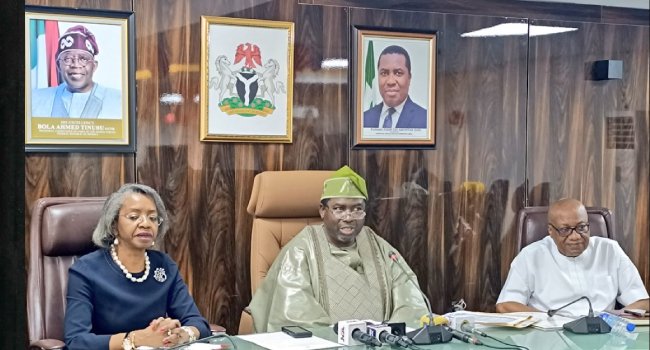
During a week-long visit to Osun ahead of the election, the Chairman of the Independent National Electoral Commission, Professor Joash Amupitan, assured residents that vote buying would not be allowed to undermine the poll.
At an interactive session with journalists at the Osun INEC headquarters in Osogbo on August 1, Amupitan announced that the electoral body would work with the Economic and Financial Crimes Commission and the Independent Corrupt Practices and Other Related Offences Commission to tackle vote trading.
He said vote buying had increasingly moved beyond physical cash exchanges at polling units to digital transfers and the pre-election harvesting of voters’ bank details.
Amupitan added that INEC could also collaborate with the Nigerian Financial Intelligence Unit and the Office of the Attorney-General of the Federation, while plain-clothes anti-corruption officers would monitor areas around polling units and arrest suspected vote buyers and sellers.
The Commissioner of Police for the Osun election, Samuel Etaifo, also made his first public appearance since his appointment at the event.
The message appeared clear: vote buying would not be business as usual.
The ICPC subsequently took its campaign to the streets of Osogbo, visiting markets, motor parks and other public places to warn residents against selling their votes.
The commission said its operatives would be deployed across all 30 local government areas on Election Day.
Speaking during one of the sensitisation rallies, the Resident Anti-Corruption Commissioner for Osun State, Yusuf Olatunji, warned that both vote buying and selling were offences punishable under Nigerian law.
He vowed that anyone involved would be arrested and prosecuted.
With INEC, ICPC and security agencies publicly declaring war on vote trading, expectations were high.
But when the ballots came out, those assurances appeared to dissolve.
WHEN THE BALLOT BECAME A MARKETPLACE
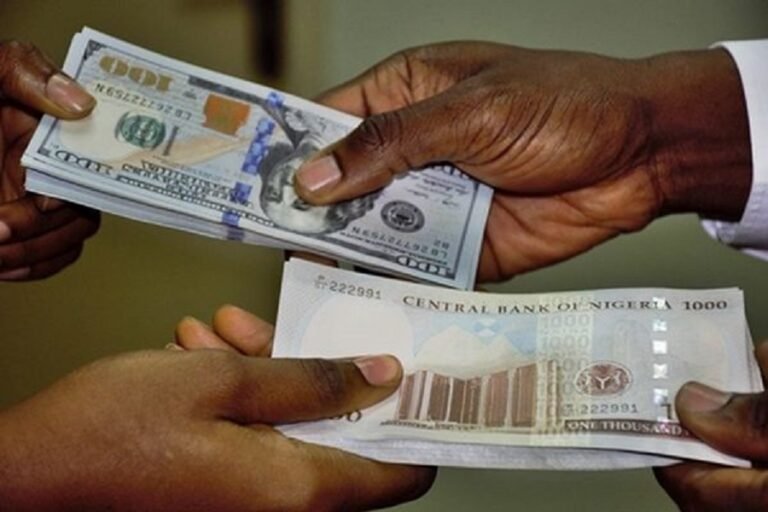
On Election Day, reports emerged from several polling locations of voters allegedly being offered cash, food items and promises of bank transfers in exchange for their support.
In some areas, political agents reportedly distributed raw food items before voting began — an attempt described by some residents as a way of “wetting the ground”.
Elsewhere, voters were asked to provide their bank details, with promises that money would be transferred after their votes had been verified.
And amid the transactions, some security personnel allegedly looked the other way.
Police officers stationed at some polling units were reportedly present as the exchanges took place but failed to intervene.
Despite the earlier announcement that ICPC operatives would be deployed across the state, the commission had, at the time of filing the report, not announced arrests arising from the alleged vote-buying activities.
For some voters, the experience exposed a troubling contradiction: the agencies responsible for stopping vote trading had promised a crackdown, yet the transactions allegedly continued openly when it mattered most.
‘A VOTE WAS N30,000, N40,000’
In Ward 05, Boripe Local Government Area, a voter who requested anonymity for security reasons described how political agents allegedly approached voters with cash.
He said he was initially offered N15,000 when he arrived at his polling unit around 10 a.m.
He declined.
But after encountering difficulties with the BVAS machine, he did not vote until about noon. By then, he said, the price had risen.
“That time, a vote was being bought for about N30,000,” he said.
According to the voter, a political party had opened a register near the polling unit for those who agreed to support it.
More troubling, he alleged, was the presence of four female police officers who watched the process without intervening.
“Four women police were present and they saw what was going on. But they didn’t raise a finger to stop it,” he alleged.
The voter also claimed that the inducement had started weeks before Election Day.
Three weeks before the election, he said, adults in his ward received N10,000 from a political party, although the distribution was presented as an empowerment programme.
The account highlights how vote buying has evolved beyond transactions conducted at polling units on Election Day.
For voters struggling with the rising cost of living, the money can be difficult to reject.
But what appears to be a small payment to an individual voter carries a much larger cost for the electoral system — the risk of turning the ballot from an instrument of choice into a commodity for sale.
And in Osun, the question after Election Day was no longer whether vote buying existed.
It was how openly it could allegedly happen despite the army of agencies that had promised to stop it.
‘N40,000 FOR A VOTE’
For Roseline, a voter in Israel Ward 8, Ilesa East Local Government Area, Election Day was not simply about walking to the polling unit, collecting a ballot paper and making a choice.
It was also, according to her account, an encounter with a marketplace where votes had a price.
Speaking to our correspondent by telephone, Roseline alleged that agents of the Accord Party and the All Progressives Congress offered money to voters at her polling unit, with the price of a vote reaching N40,000.
But there was a twist.
Some of those who collected the money, she said, eventually voted for candidates of their choice.
“Several people that got money eventually voted for their preferred candidate. Police and NSCDC operatives saw how they were paying for votes, but they didn’t caution those involved,” she said.
Her account highlights one of the complications confronting vote buying in Nigeria: the money may change hands, but the ballot remains secret.
For the voter, collecting the cash can become an economic decision; for the politician, it is an attempt to influence the outcome.
And for democracy, the transaction leaves a troubling question: what exactly is being bought when a voter takes the money but still votes according to their conscience?
‘MUDU OF GARRI’ BEFORE N20,000
In Ile-Ife, another voter said the inducement began even before voting commenced.
The voter, whose polling unit was located inside Oja Titun, said a political party agent distributed a mudu of garri to people in the market on the morning of the election.
He said he knew the woman who distributed the food items.
“She shared a mudu of garri to all of us in the market that Saturday morning before the election commenced. She didn’t make any request from us, but it was obvious she wanted us to vote for a particular candidate,” he said.
Later, after voting started, he said an agent of a political party paid him N20,000.
The two accounts — one involving N40,000 and another involving food and N20,000 — illustrate the different forms vote inducement can take, from direct cash payments to food and other items distributed before voters enter the polling booth.

For households struggling with rising food prices and mounting expenses, such offers can be difficult to ignore.
But former INEC National Commissioner, Professor Lai Olurode, believes the implications extend far beyond the immediate financial benefit to individual voters.
‘IT WAS A BAZAAR’
Reflecting on the election, Olurode described the atmosphere around some polling environments as “a bazaar”.
He said the development was dangerous for democracy because it made it difficult to determine whether voters were choosing candidates freely or responding to financial inducements.
“You won’t know what the people are really voting for. Is it the highest bidder, or are they just voting their conscience or a combination of the two?” he asked.
Olurode, however, absolved INEC of responsibility for the vote trading, arguing that the problem reflected a broader culture of monetising elections.
According to him, political actors have increasingly come to believe that elections cannot be won without substantial financial resources.
He warned that the practice could undermine not only electoral integrity but also Nigeria’s wider development.
“Corruption is widespread, and you cannot isolate your electoral practices and say we want to shield our electoral regime from corruption,” he said.
For Olurode, the way out requires sustained voter education rather than campaigns that only become visible shortly before elections.
“Maybe we should do more in terms of voter education, so that we don’t turn elections into a bazaar,” he said.
‘THE GRANDFATHER OF ALL VOTE BUYING’
Osogbo-based legal practitioner, Chief Abimbola Ige, was even more blunt in his assessment.
He described the scale of vote buying witnessed during the August 15 election as “huge”, arguing that the development was a bad omen for Nigerian democracy.
Ige alleged that some voters were offered as much as N50,000 for their votes.
“What happened on the 15th of August 2026 was the grandfather of all vote buying,” he said.
For him, the danger is not merely that politicians spend money during elections.
It is that money is gradually replacing ideas, policies and accountability as the currency of political campaigns.
He argued that candidates increasingly focus on what they can distribute to voters rather than what they intend to do for them if elected.
Yet the outcome of the Osun election also presented an interesting contradiction.
Despite the reported inducements, the incumbent governor was returned for another four-year term, leading Ige to suggest that money may not have the power politicians assume.
“It is becoming apparent that money is losing its magic wand in our electoral processes,” he said.
He urged political actors to recognise that there is a limit to what money can achieve at the ballot box.
PARTIES REJECT ALLEGATIONS
The allegations of vote buying were rejected by the political parties involved.
In separate interviews, the spokesperson for the Ademola Adeleke Governorship Campaign Council, Pelumi Olajengbesi, and the Osun APC spokesperson, Kola Olabisi, denied that their parties engaged in vote buying.
Olajengbesi, however, alleged that as much as N110 billion was brought into Osun in two tranches ahead of the election.
“Initially, there was N60bn and another N50bn, making about N110bn in a country where people are suffering, where the economy is suffering,” he alleged.
The allegation could not be independently verified.
Olabisi dismissed the claim, insisting that the APC had no reason to buy votes because its candidate was sufficiently popular to win the election.
He challenged those making the allegation to provide evidence.
“Anybody can make an allegation, but any allegation that is not supported with fact is as good as torn paper,” he said.
For voters who stood inside the polling units, however, the debate over who spent what may be less important than the experience they witnessed.
In one place, a voter alleged, N40,000 was offered.
In another, a mudu of garri preceded a N20,000 payment.
And in the middle of it all stood the ballot — supposedly secret, supposedly sacred, but increasingly surrounded by the language of cash and transactions.
The question now is whether Nigeria’s elections can remain genuinely competitive when the price of political participation is increasingly being set in naira.